🎯 Key Takeaways
- Large Language Models adapted for genomics can analyze DNA sequences as "biological language"
- Applications include variant interpretation, drug target identification, and protein structure prediction
- Models like AlphaFold have already solved protein structure prediction, a 50-year scientific challenge
- AI-driven genomics is accelerating drug discovery timelines from 10+ years to potentially 2-3 years
- Ethical considerations around bias, data privacy, and interpretability remain active challenges
AI in Modern Healthcare
Artificial intelligence has rapidly become one of the most transformative forces in modern healthcare. From diagnostic imaging analysis that detects tumors with higher accuracy than individual radiologists, to clinical decision support systems that help physicians choose optimal treatment plans, AI is reshaping every aspect of medical care.
The global AI in healthcare market is projected to reach $188 billion by 2030, reflecting the enormous investment and adoption across hospitals, research institutions, and pharmaceutical companies. Among the most exciting frontiers is the application of large language models to genomics, where the parallels between natural language processing and DNA sequence analysis have opened remarkable new possibilities.
What Are Large Language Models?
Large Language Models (LLMs) are a class of artificial intelligence systems trained on massive datasets to understand, generate, and analyze sequential data. While most people know LLMs through text-based applications like chatbots, the underlying architecture, particularly the transformer model, is remarkably versatile.
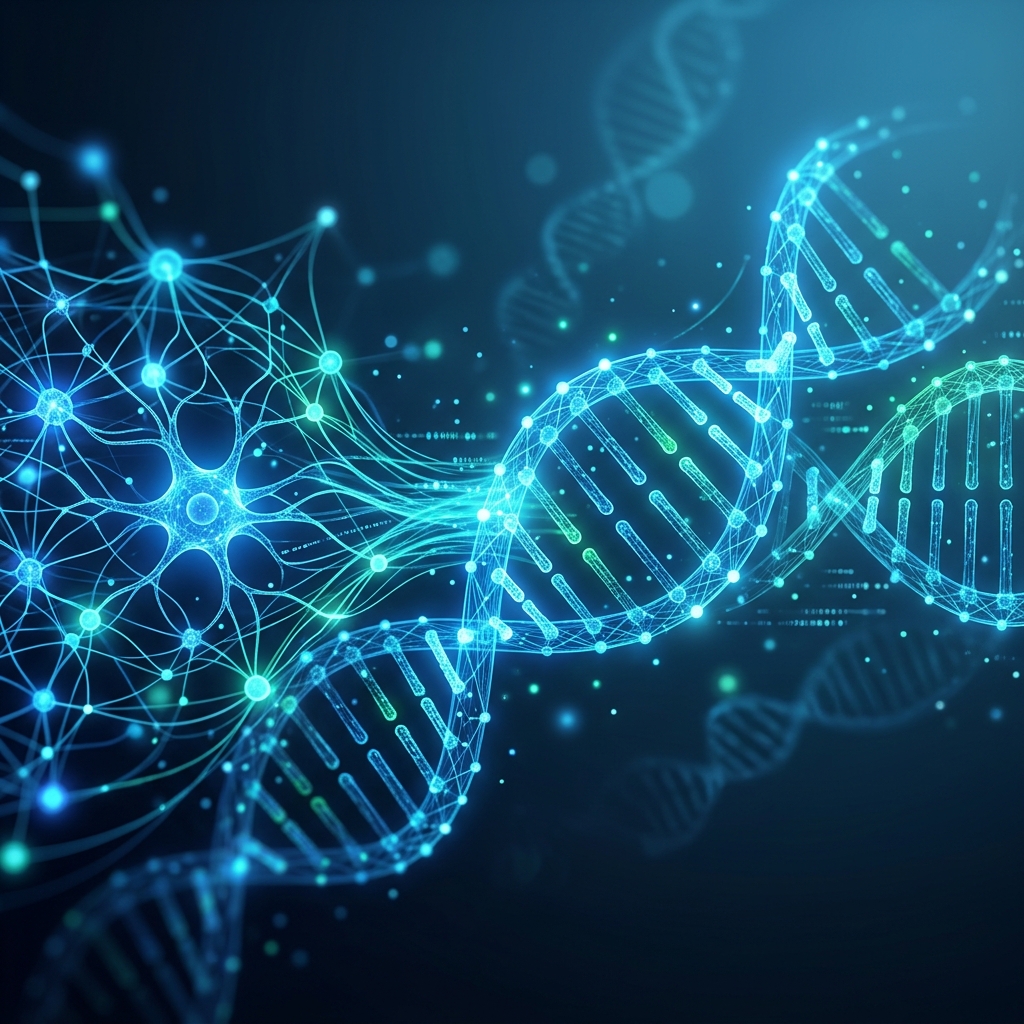
The key insight that enables genomic LLMs is that DNA can be treated as a four-letter language (A, T, G, C nucleotides) with its own grammar, syntax, and semantics. Just as text LLMs learn the patterns and rules of human language, genomic LLMs learn the patterns and rules encoded in DNA sequences, including regulatory elements, gene structures, and evolutionary conservation.
Applications in Genomics
DNA Sequence Analysis and Interpretation
Genomic LLMs excel at identifying functional elements within DNA sequences. They can predict which genetic variants are likely to be harmful versus benign, identify regulatory regions that control gene expression, and detect structural patterns that influence protein function.
For example, models trained on human genome data can now classify variants of uncertain significance (VUS) with accuracy levels approaching that of expert clinical geneticists. Given that approximately 40% of all genetic test results return VUS classifications, this capability has significant clinical impact.
Gene Function Prediction
Understanding what each gene does and how genetic variants affect its function is one of the grand challenges of biology. Genomic LLMs can predict gene function from sequence alone, identifying potential disease connections that would take years to establish through traditional experimental methods.
Discover how personalized medicine applies genomic insights to create targeted treatments.
Read About Personalized Medicine →Protein Structure Prediction
Perhaps the most celebrated achievement of AI in biology is AlphaFold, developed by DeepMind. This AI system solved the protein folding problem, predicting 3D protein structures from amino acid sequences with experimental-level accuracy. The AlphaFold Protein Structure Database now contains predicted structures for over 200 million proteins, covering nearly every known protein across all life forms.
This achievement has profound implications for drug discovery, as understanding protein structure is essential for designing targeted medications. What previously required months of laboratory crystallography can now be accomplished in minutes.
Drug Discovery and Development
AI-powered genomic analysis is revolutionizing pharmaceutical research in several ways:
- Target identification: LLMs can analyze disease-associated genetic data to identify new drug targets in weeks rather than years
- Drug-gene interactions: Predicting how specific genetic variants will affect drug response, enabling more precise clinical trials
- Synthetic biology: Designing novel biological molecules (antibodies, enzymes, therapeutic proteins) with desired properties
- Repurposing existing drugs: Identifying new therapeutic applications for approved medications based on genomic insights
Several AI-designed drugs have already entered clinical trials, and the first AI-discovered drug (for idiopathic pulmonary fibrosis) reached Phase II trials in record time. Industry estimates suggest AI could reduce the average drug development timeline from 12-15 years to as few as 3-5 years.
🩺 Doctor's Note
While AI-driven genomic analysis is highly promising, it is important to understand that these tools augment, rather than replace, clinical judgment. AI models can have biases based on training data (which has historically underrepresented diverse populations) and may produce false positives or negatives. Genomic test results should always be interpreted by qualified healthcare professionals in the context of a patient's complete medical history.
Benefits and Risks
Benefits
- Dramatically faster analysis of genomic data (from weeks to minutes)
- Detection of subtle patterns invisible to human analysis
- Democratization of genomic expertise to underserved regions
- Acceleration of rare disease diagnosis
- More efficient and targeted drug development
Risks and Challenges
- Data bias: Training datasets overrepresent European ancestry populations, potentially reducing accuracy for other groups
- Interpretability: Complex AI models can be "black boxes," making it difficult to explain clinical recommendations
- Privacy concerns: Genomic data is the ultimate personally identifiable information and requires robust protection
- Regulatory gaps: Current regulatory frameworks are still adapting to AI-driven clinical tools
- Over-reliance: Risk of clinicians deferring too heavily to AI recommendations without critical evaluation
Learn how AI and data science are shaping other areas of modern healthcare.
Explore AI in Healthcare →The Road Ahead
The convergence of AI, genomics, and healthcare is still in its early stages, but the trajectory is clear. In the coming years, we can expect multi-modal AI models that integrate genomic, proteomic, imaging, and clinical data for comprehensive patient analysis. Foundation models specifically designed for biology and medicine will continue to grow in capability and accuracy.
Federated learning approaches will enable AI training across institutions without sharing sensitive patient data. And as diverse genomic datasets expand, the accuracy of AI predictions will improve across all populations, moving us closer to truly equitable precision medicine.
The ultimate vision is a healthcare system where every patient's treatment is informed by a deep understanding of their unique biology, powered by AI that can process and interpret the vast complexity of the human genome in real-time.
⚡ Quick Summary
AI large language models are transforming genomics by treating DNA as a biological language that can be analyzed for patterns, predictions, and insights. From protein structure prediction to drug discovery acceleration, these tools are making precision medicine more achievable than ever. While challenges around bias, privacy, and interpretability remain, the potential to improve healthcare outcomes for billions of people makes this one of the most impactful fields in modern science.
Sources & References
- Jumper, J., et al. (2021). "Highly accurate protein structure prediction with AlphaFold." Nature, 596(7873), 583-589.
- Nguyen, E., et al. (2024). "Sequence modeling and design from molecular to genome scale with Evo." Science, 386(6723).
- Topol, E. J. (2023). "As artificial intelligence goes multimodal, medical applications multiply." Science, 381(6663), 1272.
- Accenture. (2024). "AI in Healthcare: Market Analysis and Growth Projections." Accenture Research.